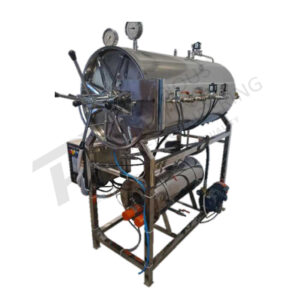
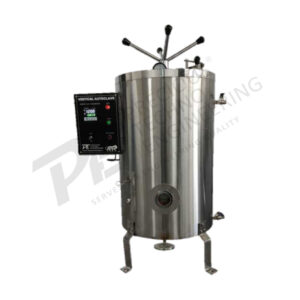
KEY FEATURES
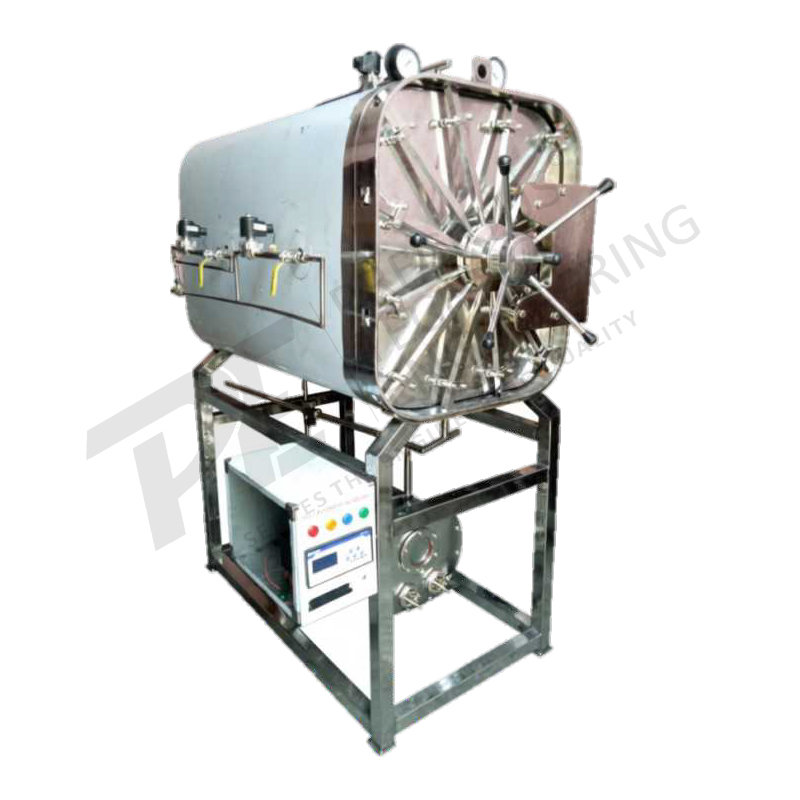
Rectangular horizontal chamber design:
- Unlike cylindrical units, the internal chamber is rectangular (width × height × depth) which often allows better use of space, easier loading of trays/trolleys and higher capacity.
- The unit sits horizontally (front‐loading, single door or double door), often on a heavy stand.
Construction and materials:
- Inner chamber, jacket and outer casing typically made of stainless steel (SS-304 or SS-316) for corrosion resistance and durability.
- Often triple‐walled: inner chamber, steam jacket, outer shell, with insulation (glass wool/mineral wool) in between to reduce heat loss and external surface temperature.
- Heavy gauge welded joints, radial locking/ Vertical Sliding locking door, robust safety interlocks.
Steam generation / jacketed chamber:
- Steam jacket surrounds the chamber to ensure uniform sterilization, good heat transfer and short cycle times.
- Some models include built‐in steam generator/boiler; others connect to external steam.
High pressure / High temperature capability:
- Working pressures typically in the range ~15–30 psi (≈1.0-2.0 kg/cm²) and temperatures around 121 °C standard, upgradable to ~134 °C or more for faster cycles.
- Hydraulic/pressure testing to 2.5× working pressure or higher to ensure safety.
Control & safety features:
- Pressure gauges, safety valves, vacuum breaker, water level indicators, automatic low water cut‐ off, door interlocks (cannot open under pressure) are standard.
- Digital PID controllers, timers, touch‐screen HMI/PLC systems available for more advanced models — allows preset cycles, data logging, diagnostics.
Internal Carriage:
- This is the mobile cart, usually made of stainless steel, that holds the items to be sterilized (trays, baskets, racks, etc.).
- It has shelves or multiple levels and is designed to fit precisely within the autoclave chamber.
- The cart is wheeled or rolled directly into the sterilizer chamber on internal tracks.
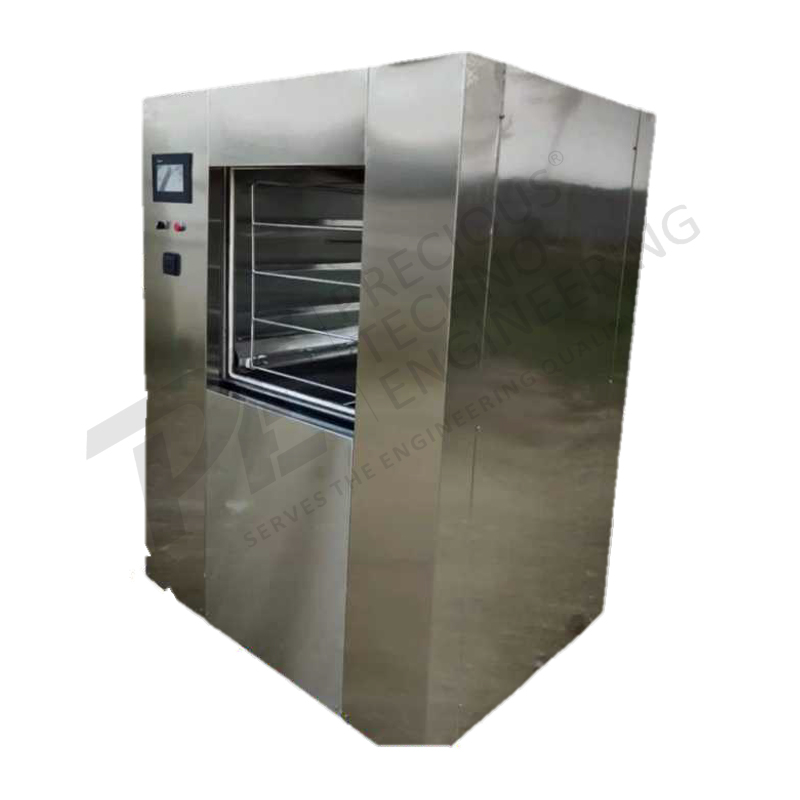
Salient Features For Sliding Door Autoclave
- Door Mechanism: The sliding door is usually pneumatically or motor-driven and often features an automatic sealing ring (gasket) that inflates with air pressure for a secure seal during the sterilization cycle and retracts for opening. The sliding motion saves floor space compared to a hinged, swing-out door.
- Safety Interlocks: A crucial feature is the comprehensive safety interlock system, which ensures the door cannot be opened:
o If the chamber is pressurized.
o (For double-door models) If the opposite door is open (door inter-lock).
o (For double-door models) On the non-sterile side after a successful cycle, until the sterile side door is closed.
o Cycle start is prevented if the door is not properly closed and locked.
- Operating Cycles: They are often advanced, fully automatic, and PLC-controlled, capable of running various
sterilization cycles, including:
o Pre-Vacuum/Pulsing Cycle: Uses a vacuum pump to efficiently remove air from the chamber before steam injection, which is essential for sterilizing porous, wrapped, or hollow items.
o Gravity Displacement Cycle: Relies on steam to displace the heavier air.
o Liquid Media Cycle: Features controlled cooling and pressure release to prevent liquids from boiling over.
o Test Programs: Such as the Bowie-Dick test (steam penetration) and Vacuum Leak Test.